


19 Jul The Ultimate Guide to Real Estate Investment Management Software: Benefits, Features and Pricing
Managing a real estate portfolio in the United States has never been more complex. Rent collection, maintenance tracking, lease administration, investor reporting, and regulatory compliance all compete for your attention at once. Doing all of this manually leaves room for costly errors and missed opportunities. That is why thousands of US landlords, property managers, and institutional investors have turned to dedicated software to keep everything organized and running smoothly.
This guide explains what real estate investment management software does, why it matters, which features to look for, how leading platforms are priced, and how to choose the right tool for your portfolio.
What Real Estate Investment Management Software Does
Real estate investment management software is a digital platform that centralizes the operational, financial, and administrative tasks involved in running a property portfolio. It replaces spreadsheets, paper files, and disconnected apps with a single connected system.
The US Census Bureau estimates there are approximately 20 million individual landlords in the United States, and the majority still rely on manual processes. Software changes that equation immediately. Whether you manage three units or three thousand, the right platform reduces administrative overhead, improves cash flow visibility, and helps you make faster, better-informed investment decisions.
At the institutional level, these platforms support complex investor reporting, GAAP-compliant accounting, multi-entity consolidation, and Sarbanes-Oxley compliance frameworks. At the individual landlord level, they handle rent collection, tenant screening, and maintenance requests through a simple dashboard.
Key Benefits for US Property Investors
The advantages of adopting real estate investment management software go well beyond convenience. Here are the most significant gains US investors consistently report.
- Faster rent collection through automated online payment processing and reminders.
- Reduced accounting errors with built-in trust accounting and automated bank reconciliation.
- Better tenant experience through self-service portals for maintenance requests and lease renewals.
- Stronger investment decisions through real-time portfolio analytics and performance benchmarking.
- Simplified tax preparation with tax-ready financial statements generated automatically at year end.
- Improved compliance with fair housing laws, lease terms, and local regulations through automated alerts and audit trails.
- Scalability, allowing the software to grow with your portfolio without adding administrative headcount.
Additionally, investor-facing features such as dedicated portals, automated capital call notices, and distribution tracking make these platforms essential for syndicators and fund managers raising capital from multiple investors.
Essential Features to Look For
Not all platforms are created equal. The features that matter most depend on the size and type of your portfolio. However, there are core capabilities that any serious US investor should expect from a modern platform.
Portfolio and Asset Management
The software should give you a clear, real-time view of your entire portfolio. This includes occupancy rates, lease expiration calendars, rent roll summaries, and asset-level financial performance. The ability to filter by property type, geography, or legal entity is especially important for diversified portfolios.
Accounting and Financial Reporting
Look for enterprise-grade accounting that meets GAAP standards. Key capabilities include general ledger management, automated bank reconciliation, accounts payable and receivable, multi-entity consolidation, and customizable financial reports. For commercial portfolios, CAM reconciliation and percentage rent calculations are non-negotiable.
Tenant and Lease Management
Lease tracking, automated rent escalations, renewal alerts, tenant communication history, and online lease signing all belong in a modern platform. For residential managers, tenant screening integration with credit and background check services adds significant value.
Maintenance and Work Order Management
Tenants submit repair requests through a portal. The system logs, routes, and tracks each request through to completion. Automatic reminders for scheduled inspections and preventive maintenance reduce deferred maintenance costs over time.
Investor Relations and Reporting
For syndicators and fund managers, a dedicated investor portal is essential. Investors should be able to log in, view distributions, download K-1s, review deal documents, and track their position in real time. Automated capital call and distribution notices reduce the administrative burden on the GP team significantly.
AI and Analytics
The most competitive platforms in 2026 use AI-powered tools for revenue management, predictive maintenance, market benchmarking, and vacancy pricing. RealPage, for example, uses its YieldStar system to recommend pricing based on demand signals, comparable properties, and seasonality. These tools can meaningfully improve net operating income without adding staff.
Third-Party Integrations
The platform should connect cleanly with your existing banking, accounting, and CRM tools. Look for integrations with QuickBooks, Xero, Sage Intacct, NetSuite, and major tenant screening providers. Open-platform systems like MRI Software are particularly strong here, allowing operators to build a custom technology stack around the core platform.
Leading Platforms in the US Market
The following table summarizes the most widely used real estate investment management platforms in the United States, with verified 2026 pricing and ideal use cases.
| Platform | Starting Price | Best For | Key Strength |
| Yardi Breeze | From $1 per unit per month (min $100) | Small to mid-size residential portfolios | Affordable entry to the Yardi ecosystem |
| Yardi Voyager | From $1,200 per month | Large enterprise and institutional portfolios | All-in-one stack for mixed-use, multifamily and commercial |
| MRI Software | From $55 per month | Commercial and mixed-use portfolios | Open-platform architecture and class-leading lease administration |
| AppFolio Core | $1.40 per unit per month (min 50 units) | Small to mid-size residential managers | Ease of use and mobile accessibility |
| AppFolio Plus | $3.00 per unit per month (min 300 units) | Growing residential operators | Workflow management and enhanced reporting |
| AppFolio Max | $5.00 per unit per month (min 1,500 units) | Large-scale residential operators | Full enterprise feature set |
| Buildium | From $62 per month | Small to mid-size residential | Clear pricing tiers and straightforward onboarding |
| RealPage | Custom pricing | Large multifamily operators | AI-powered YieldStar revenue management |
| Entrata | Custom pricing | Mid to large multifamily | Strong user experience and resident engagement tools |
| Baselane | Free | Landlords seeking integrated banking | Banking, bookkeeping, and rent collection in one free platform |
| TenantCloud | From $1 per unit per month | Small landlords | Lease management and maintenance for growing portfolios |
| RentPost | From $29 per month plus $1 per unit | Small to growing landlords | Accessible pricing and a 30-day free trial |
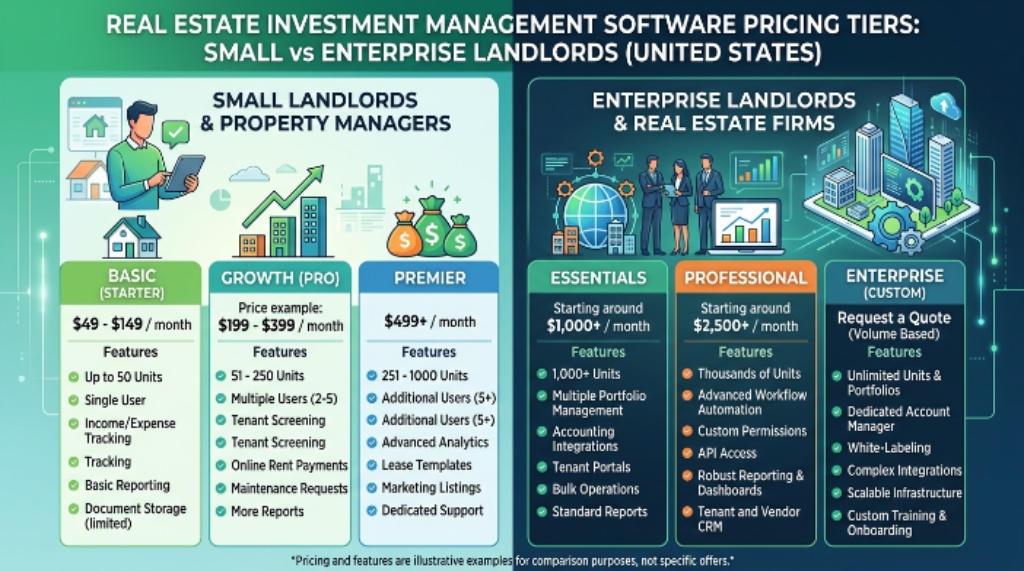
Entry-level pricing plans typically start around $20 per month, while premium platforms with advanced features range up to $85 per month or higher for fixed plans. Enterprise platforms like Yardi Voyager and RealPage require custom quotes and typically involve significant implementation costs. However, for large portfolios, the per-unit savings and operational efficiency gains more than justify the investment.
How to Choose the Right Platform for Your Portfolio
The right software depends on three things: the size of your portfolio, the types of properties you manage, and the complexity of your investor relations.
For landlords managing fewer than 50 units, Baselane, TenantCloud, RentPost, or Buildium offer the best balance of features and affordability. These platforms are easy to set up and do not require lengthy implementation cycles.
For residential operators managing between 50 and 1,500 units, AppFolio offers tiered pricing that grows with your portfolio. Its Core, Plus, and Max plans allow you to start with the basics and unlock more powerful tools as your business scales.
For commercial operators managing office, retail, or industrial assets with complex lease structures, MRI Software is the most cited choice. Its lease administration engine handles percentage rent, CAM reconciliation, and complex rent escalations in ways that multifamily-first platforms cannot.
For large institutional operators managing mixed portfolios across multiple asset classes, Yardi Voyager remains the market standard. Its fully integrated stack covering accounting, leasing, and investor reporting makes it the preferred choice for operators managing 1,000 or more units.
For syndicators and fund managers, look for platforms that include dedicated investor portals, waterfall modeling, capital call automation, and distribution tracking. Juniper Square and Investor Management Services (IMS) specialize in this segment.
Additionally, always test at least two platforms with a free trial before committing. Implementation timelines for enterprise platforms range from three to six months, so it is worth investing time in evaluation upfront.

Pricing Models Explained
Real estate investment management software in the US uses three main pricing structures.
Per-unit monthly pricing scales naturally with portfolio size. It is the most common model for residential platforms. Costs range from $1 per unit for entry-level tools to $5 per unit for enterprise residential platforms.
Fixed monthly pricing offers a predictable cost regardless of unit count. This works well for smaller portfolios where per-unit pricing would be disproportionately expensive.
Custom enterprise pricing applies to large or complex deployments. Platforms like Yardi Voyager, RealPage, and Entrata base their pricing on portfolio size, module selection, implementation requirements, and the level of ongoing support needed. Always request a detailed quote and ask specifically about implementation fees, data migration costs, and annual price escalation clauses.
Conclusion
Real estate investment management software gives US investors a clear operational and financial edge in an increasingly competitive market. The right platform centralizes your accounting, lease management, tenant communications, maintenance tracking, and investor reporting in one place, freeing you to focus on growing your portfolio rather than managing paperwork. Entry-level tools like Baselane and RentPost make sophisticated management accessible to small landlords at low or no cost. Mid-market platforms like AppFolio and Buildium scale efficiently with growing residential portfolios. Enterprise systems like Yardi Voyager and MRI Software serve the complex needs of institutional operators and commercial asset managers. Before committing, assess your portfolio size and type, evaluate your investor reporting requirements, and take advantage of free trials wherever available. The right choice will save you time, reduce errors, and put better data in front of every decision you make.
Frequently Asked Questions
What is real estate investment management software and who needs it?
It is a digital platform that centralizes the operational, financial, and administrative tasks involved in managing a property portfolio. It is useful for individual landlords, residential property managers, commercial operators, syndicators, and institutional investors. Anyone managing more than a handful of units will typically find that the time saved and errors avoided justify the cost.
How much does real estate investment management software cost in the US?
Pricing varies widely. Free options like Baselane serve small landlords who need banking and rent collection tools at no cost. Entry-level paid platforms start around $20 to $29 per month or $1 per unit per month. Mid-market platforms like AppFolio range from $1.40 to $5 per unit per month depending on the tier. Enterprise platforms like Yardi Voyager start at $1,200 per month for full deployments and require custom quotes for larger implementations.
What is the best platform for small landlords in the United States?
Baselane is widely recommended for landlords with ten or more units who want to centralize banking, bookkeeping, and rent collection at no cost. RentPost and TenantCloud are strong alternatives for landlords who want additional features such as tenant screening and maintenance tracking at an affordable per-unit price. Buildium is also popular among smaller residential managers for its clear pricing tiers and straightforward setup.
Which platform is best for commercial real estate operators?
MRI Software is the most commonly cited choice for commercial operators managing office, retail, or industrial assets with complex lease structures. Its class-leading lease administration engine handles CAM reconciliation, percentage rent, and complex escalation schedules better than most multifamily-first alternatives. Yardi Voyager is the preferred choice for large institutional operators managing mixed portfolios that include both residential and commercial assets.
How long does it take to implement real estate investment management software?
Implementation time depends on the complexity of the platform and the size of the portfolio. Simple platforms like Baselane, Buildium, or TenantCloud can be up and running within a few days. Mid-market platforms like AppFolio typically take a few weeks to configure and migrate data. Enterprise platforms like Yardi Voyager and MRI Software typically require three to six months from contract signing to go-live, including data migration, staff training, and system configuration.
Sorry, the comment form is closed at this time.