


16 Sep Distance vs. Control: Finding the Right Golf Ball for Your Game
You stand on the tee, aiming down a fairway that seems to stretch forever. You want the satisfaction of a long, powerful drive, but you also know a wild shot will ruin the hole. This is the classic dilemma every golfer faces: the quest for maximum distance versus the need for pinpoint control. It’s a trade-off that defines golf ball design, and understanding it is key to lowering your scores. As covered in resources like The Hickory Golf Hub blog, the ball you choose is a critical piece of equipment that should match your swing and strategy. This guide will help you navigate that choice, moving beyond marketing claims to find the right ball for your specific game
Quick Answer
Choosing between a distance and a control golf ball depends on your priorities and skill level. Distance balls are designed for lower spin and a harder feel to maximize yardage for players with slower swing speeds. Control (or tour) balls offer a softer feel and higher spin for better stopping power on greens and workability, but can sacrifice some distance. Most golfers benefit from a balanced, mid-range ball that offers a compromise between the two.
Key Takeaways
- Distance vs. Control is a Trade-Off: Golf ball design is a zero-sum game in many ways; adding spin for control often reduces distance, and reducing spin for distance costs you greenside stopping power.
- Swing Speed is a Major Factor: A high-spin tour ball can actually travel farther for a high-swing-speed player, while a low-spin distance ball is often longer for a moderate or slow-swing-speed player.
- Prioritize Your Weakness: If you struggle to hold greens, a control ball will help more than extra yards off the tee. If you need every bit of distance you can get, a distance ball is the logical choice.
- Compromise is Key: The vast majority of recreational golfers are best served by a mid-range ball engineered to provide a useful blend of distance, feel, and short-game control.
- Test on the Course: Launch monitor data and marketing claims are helpful, but the final decision should be based on how a ball performs on your home course, especially on and around the greens.
The Core Conflict: How Golf Ball Design Creates a Trade-Off
The difference between a distance and a control ball comes down to two main design features: the core and the cover. Think of it as a layered system where each part influences performance.
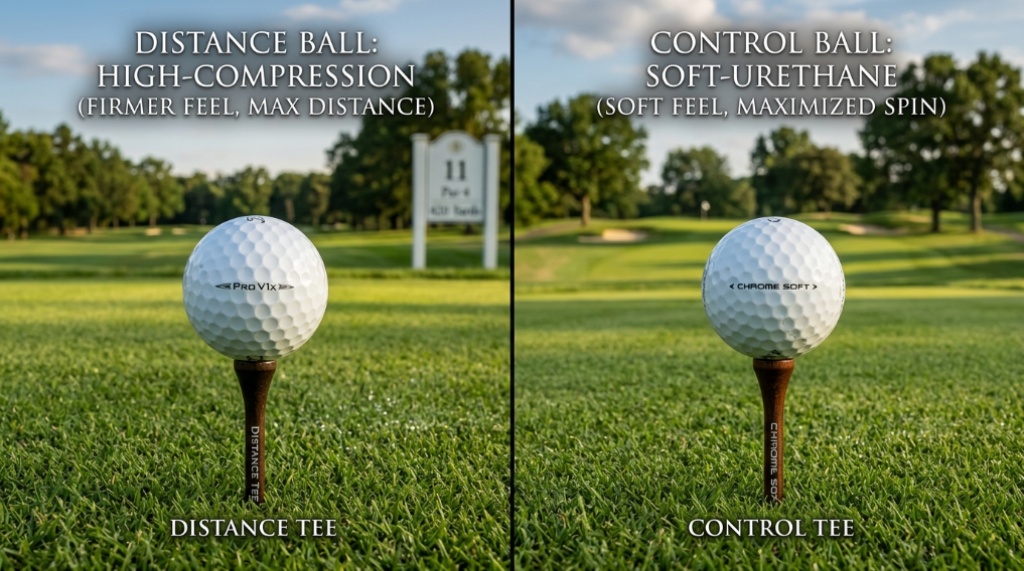
Distance golf balls typically feature a large, rigid core and a thin, harder cover (often made of a material called Surlyn). The hard core is designed to react powerfully at impact, transferring energy into the ball for maximum velocity. The hard cover contributes to a lower spin rate, especially with the driver. Why? Less spin means less sideways movement (sidespin) and less backspin, which can help the ball fly straighter and roll out farther after landing. The compromise is a firmer feel and a lack of grip on the clubface for short-game shots, making it harder to generate the spin needed to stop the ball quickly on the green,to improve your swing mechanics further, explore how golf schools shape modern golfers to transform your overall performance.
Control golf balls, often called “tour” or “urethane” balls, use a softer, multi-layer core and a soft, thin urethane cover. The soft cover grabs the clubface at impact, particularly with wedges and irons, creating a high rate of spin.
Which Ball is Right for You? A Player Profile Guide
The best way to choose is to be honest about your game. There’s no single “best” ball, only the best ball for your specific needs. Your swing speed, your typical miss, and the conditions you play in all matter.
The Case for a Distance Golf Ball
You should lean toward a distance-oriented ball if you have a moderate to slow swing speed (typically under 90 mph with a driver) and your primary goal is to maximize yardage. A lower-spin ball helps these players keep the ball in the air longer and get more roll, which translates to more total distance. If you struggle to get the ball airborne or regularly come up short on your approach shots, a distance ball can be a genuine game-changer.
The Case for a Control Golf Ball
A control ball is your best friend if you have a higher swing speed (over 95 mph with a driver) and are a consistent ball-striker. Your priority is precision, not just power. You want a ball that will land softly on firm greens and allow you to attack pins. If you rely on your short game to score and are looking to flight shots, control trajectory, and stop the ball on command, the feel and spin of a urethane-covered ball are essential. The slight loss of distance off the tee is a worthy trade-off for the scoring opportunities gained with your irons and wedges.
The Smart Compromise: Mid-Range and “Soft Feel” Golf Balls
For the vast majority of golfers—those in the middle—the best solution isn’t an extreme but a balance. Manufacturers have recognized this and offer a wide range of mid-range golf balls. These balls typically use a softer core than pure distance balls and a cover that is either a softer Surlyn or a thin urethane. The goal is to provide a blend of performance. They often offer a slightly higher spin rate than distance balls for improved short-game feel, while still maintaining a low enough spin off the driver to provide respectable distance.
When evaluating these balls, pay close attention to the feel.
Making the Decision: A Practical Testing Guide
Reading about ball characteristics is useful, but nothing beats on-course performance. Marketing jargon can be confusing, and launch monitor numbers don’t always tell the full story of how a ball performs for your swing and in your specific playing conditions. The best way to find your ball is to test methodically.
- Pick Two Options: Based on the profiles above, select one distance ball and one control ball. Don’t overcomplicate it.
- Start on the Green: This is where the biggest difference lies. Take both balls to a practice green. Chip and pitch with each from various lies. Which one feels better off the clubface? Which one checks up and stops more predictably on the greens you typically play?
- Take it to the Course: Play a few rounds with the same two balls. Alternate them on different holes. Don’t just focus on your best drives; pay attention to your misses. Does one ball seem to fly straighter and reduce the severity of your slice or hook?
- Evaluate Your Scores: After a few rounds, ask yourself a simple question: Which ball helped you shoot a better score? Did the extra distance lead to shorter approach shots, or did the extra control around the green save you strokes? For most, the strokes saved around the green will be more significant.
Frequently Asked Questions
Do low-handicap golfers always use tour balls?
While many do, it’s not an absolute rule. Some low-handicap players with lower swing speeds find that a high-spin tour ball costs them too much distance off the tee. They may opt for a mid-range ball that offers a better balance of distance and control for their specific swing profile.
What does “compression” mean in a golf ball?
Compression is a measure of how much a golf ball deforms when struck. A lower compression ball (e.g., 70-80) is softer and compresses more easily, which can be beneficial for slower swing speeds to maximize energy transfer. A higher compression ball (e.g., 90-110) is firmer and requires a faster swing speed to fully compress and unleash its full distance potential.
Why do distance balls feel “harder”?
Distance balls have a harder outer cover (like Surlyn) and a firmer core. This construction is designed for durability and to reduce spin, but it also results in less vibration being absorbed at impact, which the player perceives as a “clickier” or harder feel. Control balls use soft urethane covers for better grip and feel.
Can a control ball really go farther for some players?
Yes. For a player with a high swing speed, the higher spin rate of a control ball can actually help keep the ball in the air longer, increasing its carry distance. The aerodynamic properties of a tour ball are often optimized to make that high-spin flight stable and efficient, leading to a longer overall drive than a low-spin distance ball that might “knuckle” and fall out of the air too soon.
Conclusion
Finding the right golf ball is a personal journey of discovery. It’s about understanding your strengths and weaknesses as a player and choosing the equipment that best supports them. Test, observe, and let your performance on the course be your ultimate guide.
Sorry, the comment form is closed at this time.