

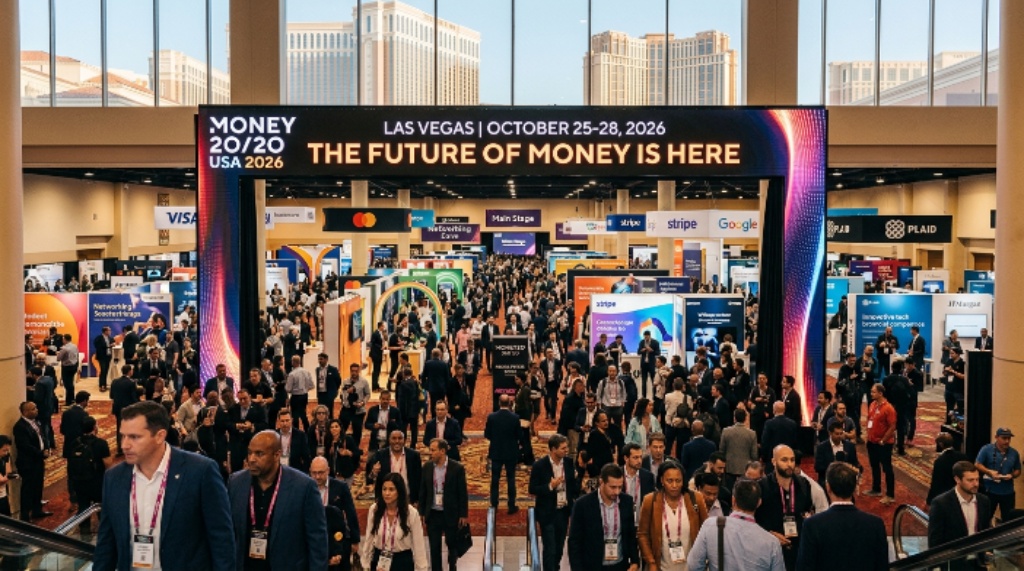
27 Jul Top Fintech Trends to Watch at Money20/20 USA 2026
The financial technology world has one unmissable annual appointment. Money20/20 USA 2026 takes place October 18 to 21 at The Venetian Expo in Las Vegas. It is the largest and most influential gathering in the global fintech calendar. Over 11,000 attendees and more than 3,400 exhibitors converge for four days of sessions, deals, and industry-defining conversations.
One in three attendees holds a C-suite title. That level of seniority makes every hallway conversation a potential turning point. This year, the agenda focuses on a handful of themes that are actively reshaping how money moves, how risk is managed, and how financial services reach people at scale.
Here is a look at the most important fintech trends expected to define the event.
Event Overview: What to Expect at The Venetian Expo
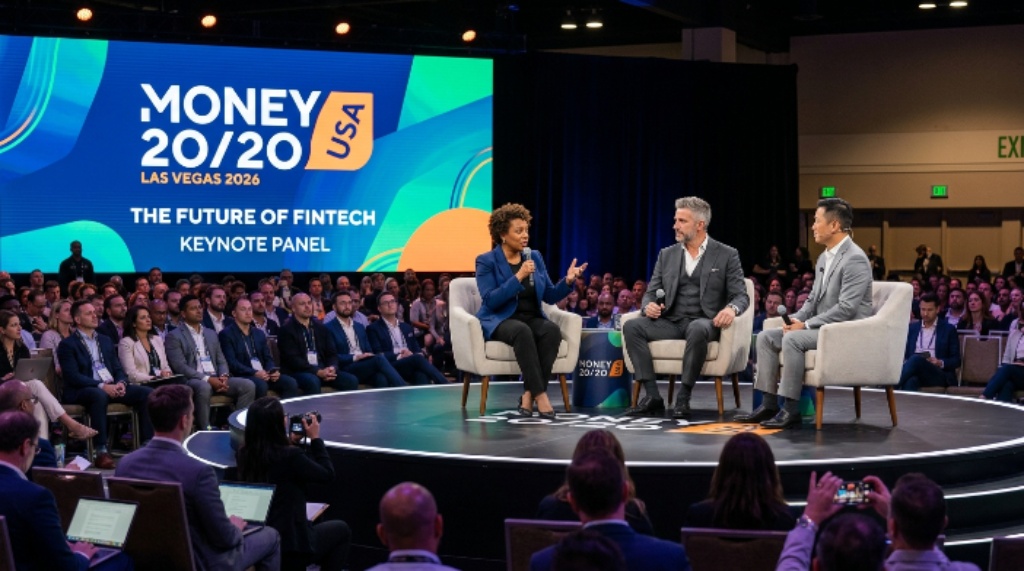
Before diving into the trends, it helps to understand the scale of the event. Money20/20 USA runs six or more stages simultaneously across the conference floor. Each stage targets a different audience and discipline.
| Stage / Track | Focus Area |
| Main Stage | Industry CEO keynotes and headline announcements |
| Payments Stage | Payment rails, infrastructure, and settlement |
| Banking Stage | Traditional banks and challenger institutions |
| Fintech & Startup Stage | Operators, investors, and emerging companies |
| Regulation & Policy Stage | Compliance, legislation, and governance |
| Emerging Tech Stage | AI, crypto, digital assets, and innovation |
Side events, investor dinners, and partner breakfasts extend the experience well beyond the official agenda. The expo hall is the densest concentration of US payments and fintech vendors anywhere in the year. Therefore, both the content and the connections on offer make this event uniquely valuable.
Agentic AI: From Pilot Projects to Real Operations
Artificial intelligence is not a new topic at fintech conferences. However, what is new in 2026 is the shift from AI as a support tool to AI as an autonomous operator. Agentic AI refers to systems that can plan, decide, and act independently — without a human approving each step.
Banks and payment networks are now deploying AI agents that handle loan origination workflows, detect fraud in real time, and respond to customer service queries end to end. Mastercard has already demonstrated agentic payment capabilities publicly. ARK Invest projects that 25 percent of all consumer e-commerce spending will involve AI agents by the end of the decade.
At Money20/20 USA, attendees can expect sessions on how institutions are moving these systems from pilot into production. The discussions will cover trust frameworks, liability questions, and the technical standards needed to make agentic finance safe at scale.
Additionally, the conference agenda confirms sessions on AI in fraud prevention. Criminals are using AI-powered bots to attack banking and payments infrastructure at speed. Financial institutions are responding with AI defenses of their own. This arms race between attacker and defender is one of the most urgent conversations in the industry.
Finance-as-a-Service: Embedding Finance Everywhere
Embedded finance is no longer an emerging concept. It is becoming the default architecture for how financial products reach consumers. The idea is simple: financial services appear inside non-financial platforms — at the point where the customer already is.
A retail app that offers buy-now-pay-later at checkout is one example. A logistics platform that provides invoice financing to suppliers is another. Embedded finance removes the need for a customer to visit a bank at all.
The Finance-as-a-Service model, known as FaaS, enables this by allowing companies to plug financial capabilities into their products through APIs. The Money20/20 USA 2026 agenda lists FaaS as a dedicated theme, reflecting how central this model has become.
| Embedded Finance Example | Industry | Financial Product Embedded |
| Ride-share driver earnings advance | Transport | Instant pay and credit |
| E-commerce checkout BNPL | Retail | Consumer lending |
| Freelance platform insurance | Gig economy | On-demand coverage |
| B2B marketplace invoice finance | Logistics | Working capital |
| Travel booking FX conversion | Hospitality | Currency exchange |
The opportunity for non-financial businesses is significant. However, the regulatory complexity of delivering licensed financial services inside a non-financial product remains a genuine challenge. Sessions at the event will address how companies navigate licensing, compliance, and consumer protection requirements in this model.
Real-Time Payments: The New Baseline Expectation
Instant payments have moved from a competitive differentiator to a basic customer expectation. Consumers and businesses now expect payments to settle immediately, around the clock, every day of the year.
In the United States, the FedNow service and the RTP network from The Clearing House provide the infrastructure for real-time domestic payments. Adoption has been accelerating. Banks of all sizes are connecting to these rails and building products on top of them.
The 2026 agenda at Money20/20 USA is expected to cover multi-rail payment strategies. This refers to the ability of modern payment systems to select the best rail for each transaction based on cost, speed, risk, and settlement requirements. Rather than relying on a single network, smart payment orchestration chooses dynamically between cards, ACH, real-time rails, and emerging alternatives.
Cross-border payments are also accelerating. New corridors are connecting domestic instant payment rails with tokenized settlement options. For businesses that operate internationally, this means faster clearing, lower fees, and fewer dependencies on correspondent banking chains that add days to settlement times.
Stablecoins and Digital Assets: Moving Into the Mainstream
Stablecoins are no longer on the edge of the financial system. They are moving into regulated infrastructure. The passage of the GENIUS Act in the United States in July 2025 created a unified legal framework for stablecoins and payment-related digital assets. This legislative clarity has given financial institutions the confidence to begin building stablecoin-based settlement solutions in earnest.
At previous Money20/20 events, the conversation around digital assets focused on whether they had a place in mainstream finance. That debate is over. The focus now is on how stablecoins are being integrated into payment networks and settlement processes at scale.
Key discussion areas expected at the 2026 event include:
- Regulated stablecoin issuance and custody standards for US financial institutions
- Cross-border B2B payments using stablecoin rails to reduce correspondent banking costs
- Tokenized money market instruments and their role in treasury management
- Central bank digital currency progress and its relationship to private stablecoin ecosystems
- Consumer protection frameworks for digital asset transactions
Additionally, the relationship between traditional banks and digital asset firms is maturing. Partnerships are replacing competition in many cases, as banks recognize that stablecoin infrastructure can complement rather than threaten existing payment business.
Fraud Prevention: Fighting AI with AI
Fraud is evolving at a pace that traditional rule-based detection cannot match. AI-powered attacks can probe payment systems continuously, adapt to security responses in real time, and target multiple institutions simultaneously. The financial cost of fraud is enormous. The reputational cost can be worse.
The response from financial institutions is increasingly to fight AI with AI. Machine learning models that analyze transaction behavior in real time are replacing static rules. These systems can flag anomalies in milliseconds and adjust their thresholds dynamically as fraud patterns shift.
Money20/20 USA 2026 has confirmed fraud as a dedicated track. Sessions will cover:
- Behavioral biometrics and how they identify genuine customers without friction
- Synthetic identity fraud and the emerging techniques used to detect it
- AI models that detect account takeover attempts at login rather than at transaction
- Collaboration frameworks that allow institutions to share fraud signals without exposing customer data
- The regulatory expectations around AI-driven fraud decisions and explainability requirements
Therefore, fraud prevention is not just a technology topic at this year’s event — it is also a compliance and governance conversation.
Open Banking and the Road to Open Finance
Open banking gives consumers the ability to share their financial data with third parties securely and with their explicit consent. It has been a regulatory requirement in several markets for years. In the United States, the Consumer Financial Protection Bureau’s open banking rule is taking effect for large banks in 2026, though its implementation has faced legal challenges and ongoing revisions.
Despite the regulatory uncertainty, the commercial momentum behind open banking is strong. The ability to access transaction data, verify income instantly, and offer personalized financial products based on real spending behavior is too valuable for fintechs and banks to ignore.
Open finance takes this concept further. It extends data sharing beyond bank accounts to include investments, pensions, insurance, and credit. The vision is a complete picture of a customer’s financial life, accessible through secure APIs, enabling products that are genuinely tailored to individual circumstances.
Money20/20 USA attendees will hear from both sides of this debate. Banks that see open data as a threat to their customer relationships will share the stage with fintechs that see it as the foundation of the next generation of financial services.
Regulation and Compliance: Adapting to a Fast-Moving Landscape
Regulators are under pressure. The pace of financial technology innovation consistently outstrips the speed of rule-making. However, 2026 represents a moment when several important regulatory frameworks are coming into effect simultaneously.
| Regulatory Development | Region | Impact Area |
| GENIUS Act (2025) | United States | Stablecoin and digital asset rules |
| CFPB Open Banking Rule | United States | Consumer data sharing |
| EU MiCA Framework | European Union | Crypto-asset regulation |
| ISO 20022 Migration | Global | Payment messaging standards |
Each of these frameworks affects how financial institutions build products, manage compliance costs, and compete for customers. Sessions at the event will address practical strategies for staying compliant without slowing down innovation.
Why Attending Money20/20 USA 2026 Matters
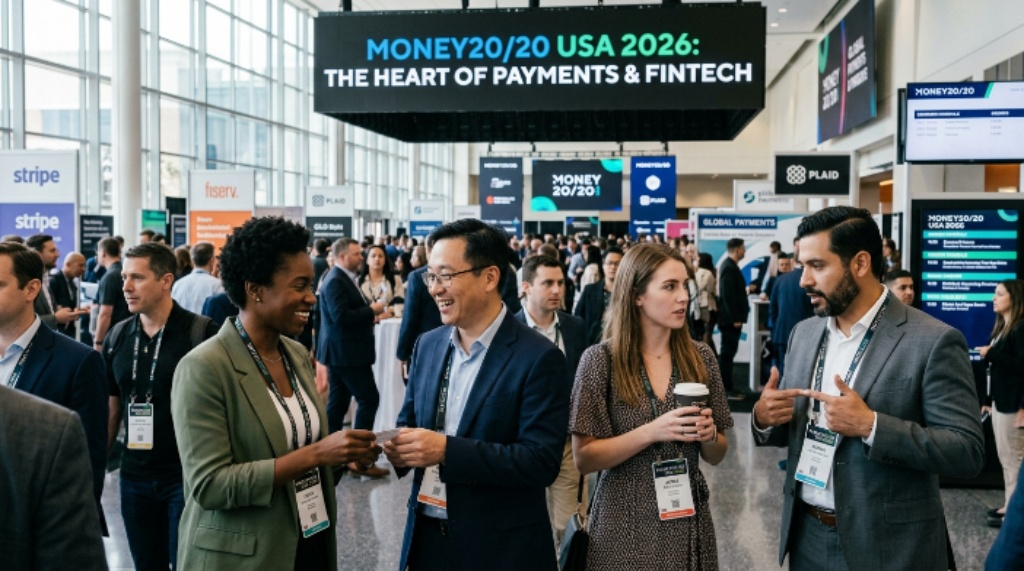
The value of attending goes beyond the agenda. Four days at The Venetian in Las Vegas generate more deals, partnerships, and strategic relationships than any other event on the fintech calendar. Companies have closed funding rounds here, met acquiring CEOs, and launched products that reached 280 or more quality leads in a single week.
For US-based fintech professionals, the event offers access to the full ecosystem in one place. Banks, payment networks, technology vendors, regulators, investors, and startups are all present. Additionally, the density of decision-makers at the C-suite level means that conversations move quickly from introductory to substantive.
Conclusion
Money20/20 USA 2026, taking place October 18 to 21 at The Venetian Expo in Las Vegas, arrives at a pivotal moment for the industry. Agentic AI is moving from experiment to operation. Embedded finance is becoming the default delivery model for financial products. Real-time payments are now a baseline customer expectation. Stablecoins are entering regulated infrastructure. Fraud prevention is an AI-versus-AI battleground. And open banking is pushing toward the more ambitious vision of open finance.
These are not distant possibilities. They are the active challenges and opportunities that financial institutions, fintechs, and technology companies are navigating right now. Money20/20 USA 2026 is where the most important decisions about how to respond will be made, discussed, and shaped. If these trends matter to your business, this is where you need to be.
Frequently Asked Questions
When and where is Money20/20 USA 2026?
Money20/20 USA 2026 runs from October 18 to October 21, 2026, at The Venetian Expo, 201 Sands Avenue, Las Vegas, Nevada. The event runs daily from 9:00 AM to 5:00 PM and is supplemented by numerous evening and side events throughout the week.
Who attends Money20/20 USA?
The event attracts over 11,000 attendees from banks, fintech companies, payment networks, technology firms, retailers, investors, startups, and regulators. One in three attendees holds a C-suite title, making it one of the most senior gatherings in the financial technology industry.
What are the key topics on the Money20/20 USA 2026 agenda?
The confirmed agenda covers agentic AI, fraud prevention, Finance-as-a-Service, payments innovation, regulation and compliance, open banking, stablecoins, and embedded finance. Multiple stages run simultaneously to serve different professional audiences across the four days.
How much does it cost to attend Money20/20 USA 2026?
Passes for Money20/20 USA 2026 start from approximately €3,670. Pricing varies by pass type and how early you register. Early registration typically offers better rates. Full pricing and registration details are available at us.money2020.com.
What is Finance-as-a-Service and why is it important in 2026?
Finance-as-a-Service, or FaaS, refers to the model where financial capabilities such as lending, insurance, and payments are delivered as plug-in services through APIs to non-financial platforms. It is important because it allows any business to offer financial products without becoming a bank, significantly expanding access to financial services and creating new revenue streams for technology companies.
Sorry, the comment form is closed at this time.