

25 Sep What Is a Business Model? Essential Guide Every Entrepreneur Must Know
Picture this: You’ve just launched what you believe is the next big thing. Your product is innovative, your branding is sleek, and your social media presence is growing. Yet six months later, you’re struggling to pay the bills, wondering where you went wrong. The harsh reality? You might have a great idea, but without a solid business model, you don’t have a business—you have an expensive hobby.
If you can’t clearly explain how your company makes money in one paragraph, you’re not ready to scale. A well-defined business model isn’t just a theoretical exercise for MBA students; it’s the engine that drives sustainable growth and profitability. Let’s dive deep into what makes a business model truly effective and why it’s the foundation every successful entrepreneur needs to master.
Understanding the Business Model: More Than Just Making Money
A business model is fundamentally an outline of how a company plans to generate revenue and achieve profitability with its product or service within a specific market. Think of it as your company’s blueprint for success—a strategic framework that answers the most critical questions about your venture’s viability.
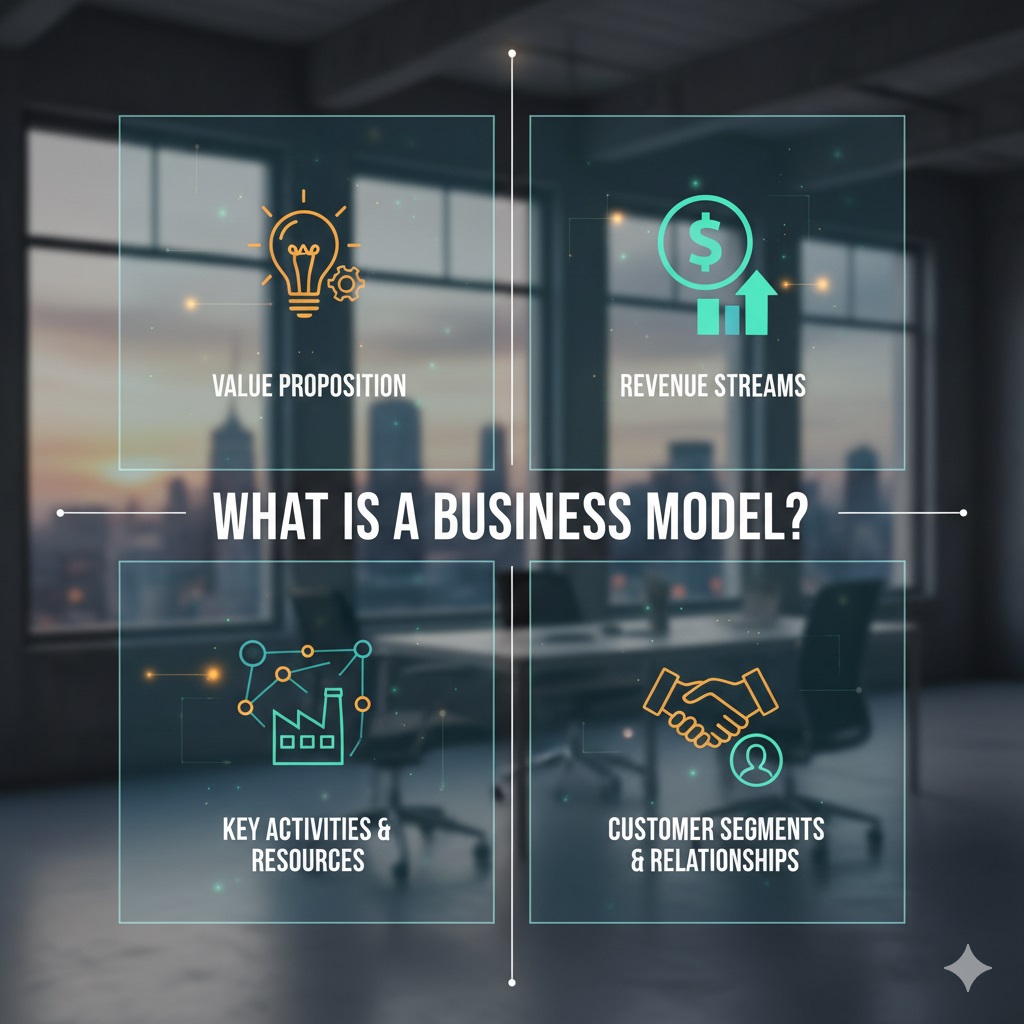
At its core, every effective business model must clearly explain four essential components:
What product or service do you offer? This goes beyond a simple description. It defines your value proposition, target market, and the specific problem you’re solving for customers.
How you’ll market and sell it – Your go-to-market strategy, distribution channels, sales processes, and customer acquisition methods.
What your main expenses will be – Understanding your cost structure, including fixed costs, variable costs, and operational expenses.
How you’ll make a profit – The revenue streams, pricing strategy, and path to profitability that sustains your business long-term.
The Critical Components of a Winning Business Model
Value Proposition: The Heart of Your Business
Your value proposition is what sets you apart from competitors and gives customers a compelling reason to choose your solution. It’s not just about having a great product—it’s about solving a real problem better than anyone else in the market.
Consider Netflix’s evolution from a DVD-by-mail service to a streaming giant. Their value proposition shifted from “convenient movie rentals” to “unlimited entertainment anywhere, anytime.” This clear value proposition guided every business decision and helped them dominate the entertainment industry.
Revenue Streams: How Money Flows In
Understanding your revenue streams is crucial for business sustainability. Whether it’s one-time sales, subscription fees, licensing, advertising revenue, or commission-based income, you need clarity on how and when money enters your business.
Successful companies often diversify their revenue streams. Amazon started with book sales but expanded to include marketplace commissions, cloud services (AWS), advertising revenue, and subscription services (Prime). This diversification creates stability and growth opportunities.
Cost Structure: Managing What Goes Out
Your cost structure encompasses all expenses required to operate your business model. This includes:
- Fixed costs (rent, salaries, insurance)
- Variable costs (materials, shipping, transaction fees)
- Customer acquisition costs (marketing, sales efforts)
- Operating expenses (utilities, software subscriptions, maintenance)
Understanding these costs helps you price your products correctly and identify areas for optimization as you scale.
Customer Segments and Market Positioning
A robust business model clearly defines who your customers are and how you’ll reach them. This isn’t about trying to serve everyone—it’s about identifying specific customer segments that value your offering most and are willing to pay for it.
Successful businesses often start by dominating a niche before expanding to broader markets. Facebook began by serving college students exclusively before opening to the general public. This focused approach allowed them to perfect their model before scaling.
Common Business Model Types and Their Applications
Subscription Model
Companies like Spotify, Adobe, and SaaS providers use subscription models to generate recurring revenue. This model provides predictable income streams and high customer lifetime value when executed properly.
Freemium Model
This model offers basic services for free while charging for premium features. LinkedIn, Dropbox, and many mobile apps successfully use this approach to acquire users at scale while monetizing power users.
Marketplace Model
Platforms like Uber, Airbnb, and eBay connect buyers and sellers, taking a commission from transactions. These models can scale rapidly once network effects take hold.
Direct Sales Model
Traditional retail and e-commerce businesses that sell products directly to consumers. This model offers high margins but requires significant marketing investment and inventory management.
The Difference Between a Business Model and a Business Plan
While often confused, business models and business plans serve different purposes. A business model is the fundamental logic of how your business creates, delivers, and captures value. A business plan is a detailed document that outlines how you’ll execute that model, including market analysis, financial projections, and operational strategies.
Your business model should be simple enough to explain in one paragraph, while your business plan might span dozens of pages. Both are important, but the business model comes first—it’s the foundation upon which everything else is built.
Red Flags: Signs Your Business Model Needs Work
Several warning signs indicate your business model requires immediate attention:
Unclear value proposition – If you can’t explain why customers should choose you over competitors in 30 seconds, your value proposition needs refinement.
No path to profitability – Burning through cash without a clear timeline to profitability is unsustainable, regardless of how innovative your product might be.
High customer acquisition costs – If it costs more to acquire a customer than they’ll ever spend with you, your model is fundamentally broken.
Lack of recurring revenue – Businesses that depend solely on one-time transactions face constant pressure to find new customers and struggle with cash flow predictability.
Building and Refining Your Business Model
Creating an effective business model is an iterative process that requires constant refinement based on market feedback and performance data. Start with these steps:
- Define your value proposition clearly – What problem do you solve, and for whom?
- Identify your revenue streams – How will you generate income from your value proposition?
- Map your cost structure – What does it cost to deliver your value proposition?
- Test and validate – Use small-scale experiments to validate assumptions before committing significant resources.
- Iterate based on feedback – Be prepared to pivot elements of your model based on real-world results.
The Role of Technology in Modern Business Models
Digital transformation has created entirely new business model possibilities while disrupting traditional industries. Platform businesses, data monetization, and AI-powered services represent just a few of the opportunities technology enables.
However, technology alone isn’t a business model—it’s an enabler. The fundamental questions of value creation, delivery, and capture remain the same, regardless of whether you’re running a tech startup or a traditional brick-and-mortar business.
Scaling Your Business Model Successfully
Once you’ve validated your business model, scaling becomes the next challenge. Successful scaling requires:
Systems and processes that can handle increased volume without proportional increases in costs.
Quality control mechanisms to maintain customer satisfaction as you grow.
Financial management to ensure cash flow remains positive during expansion.
Team building to support increased operational complexity.
Companies that scale successfully maintain the core elements of their business model while adapting operational details to accommodate growth.
Frequently Asked Questions
What’s the difference between a business model and a revenue model? A revenue model is just one component of a business model, focusing specifically on how you generate income. A business model encompasses the entire value creation and delivery system, including costs, customer segments, and operational processes.
How often should I review and update my business model? You should continuously monitor your business model’s performance, but formal reviews should occur at least quarterly. Major updates might be needed when entering new markets, launching new products, or responding to significant market changes.
Can I have multiple business models within one company? Yes, many successful companies operate multiple business models simultaneously. Amazon, for example, combines retail sales, marketplace commissions, cloud services, and advertising revenue. However, each model should be clearly defined and managed appropriately.
What’s the biggest mistake entrepreneurs make with business models? The most common mistake is focusing too heavily on the product while neglecting the business model. Having a great product means nothing if you can’t sustainably deliver it to customers at a profit.
How do I know if my business model is working? Key indicators include positive unit economics, predictable revenue growth, manageable customer acquisition costs, and a clear path to profitability. If these metrics are moving in the right direction, your model is likely sound.
Take Action: Define Your Business Model Today
Your business model isn’t just an academic exercise—it’s the difference between building a sustainable company and running an expensive hobby. If you can’t explain how your business makes money in one clear paragraph, it’s time to go back to the drawing board.
Start by answering the four fundamental questions: What do you offer? How will you market it? What will it cost? How will you profit? Write your answers down, test them with real customers, and refine based on what you learn.
Remember, even the most successful companies continuously evolve their business models. The key is starting with a solid foundation and remaining flexible enough to adapt as you learn and grow. Your future success depends not just on having a great product, but on having a great business model to support it.
Ready to build a business model that actually works? Start today by clearly defining your value proposition and testing it with your target market. Your bottom line will thank you.
Find out more:
Top AI Cloud Business Management Platform Tools Every Modern Company Needs
Sorry, the comment form is closed at this time.