

26 Sep How to Decorate Your Florida Home for Christmas Without Overdoing It
December in Florida brings a strange decorating dilemma. The calendar says winter wonderland, but the thermometer says beach weather, and the houses that try to force a northern Christmas onto a subtropical climate often end up looking cluttered, overheated, and slightly confused. The key is choosing pieces that work with Florida’s humidity, afternoon sun, and palm trees instead of fighting them. Whether you’re planning a modest porch display or piecing together a thoughtful setup, a little outside perspective helps — this Giftteen guide covers specialized outdoor options built for the state’s climate, and the approach below keeps decorations restrained, tasteful, and genuinely appropriate for a Florida holiday.
Quick Answer
To decorate a Florida home for Christmas without overdoing it, work with the climate instead of against it. Choose weather-resistant materials, use tropical greenery such as palm fronds and magnolia leaves, limit yourself to two or three colors, and invest in a few well-placed statement pieces rather than filling every surface. Skip heavy snow imagery and heat-trapping light clusters, and let the natural landscape do part of the work.
Key Takeaways
- Florida’s heat, humidity, and sun damage materials quickly, so lights, fabrics, and greenery must be rated for outdoor and humid conditions.
- A restrained color palette and fewer, larger decorations usually read better than dense, layered displays.
- Tropical elements like palm fronds, citrus, and coastal accents fit Florida’s climate far better than imitation snow.
- Motion lights and solar options can add impact without excessive wiring or clutter.
- Decorating in stages and reviewing from the street helps you stop before it becomes too much.
Why Florida Christmas Decorating Is Different
Most Christmas decorating advice assumes cold weather, dry air, and short daylight hours. Florida offers none of those reliably. Humidity warps cardboard and rusts cheap metal, intense sun fades fabric and plastic by mid-December, and afternoon storms can knock down anything not properly secured. This doesn’t mean decorations are harder to use — it means they need to be chosen differently.
The bigger issue is thematic. A thick blanket of fake snow on a Florida lawn next to a blooming hibiscus looks out of place. Rather than treating that as a limitation, it’s an opportunity to build a holiday look that’s distinctly Floridian: coastal, warm, green, and bright.
Restraint also matters more here because Florida homes often have open floor plans and large windows. Overdecorating inside becomes visible from the street, and outside decorations are visible to neighbors year-round once up. The goal should be a look that feels intentional rather than maximalist, If you are working on DIY projects around the house this season, you might also find it helpful to learn how to true a bicycle wheel at home.
Choose Materials That Survive Florida Weather
The single biggest cause of “overdone” Florida Christmas setups is not too many decorations — it’s failing ones that get patched together halfway through December. Choosing durable materials upfront prevents the cluttered, mismatched look that comes from replacing broken items on the fly.
Priorities to look for:
- UV-resistant and waterproof lights — Look for IP65 or higher ratings for anything fully exposed to rain.
- Powder-coated or stainless metal frames — Bare steel rusts quickly in coastal humidity, especially within a few miles of the ocean.
- Synthetic greenery rated for outdoor use — Real garlands and wreaths wilt within days in Florida heat.
- Fade-resistant fabrics — Solution-dyed acrylics hold color better than standard polyester under prolonged sun.
- Weighted or staked bases — Afternoon thunderstorms are common, so anything freestanding needs anchoring.
Skipping these details is what forces people to add more decorations to cover up problem areas, which is exactly how displays become overdone.
Use a Limited Color Palette
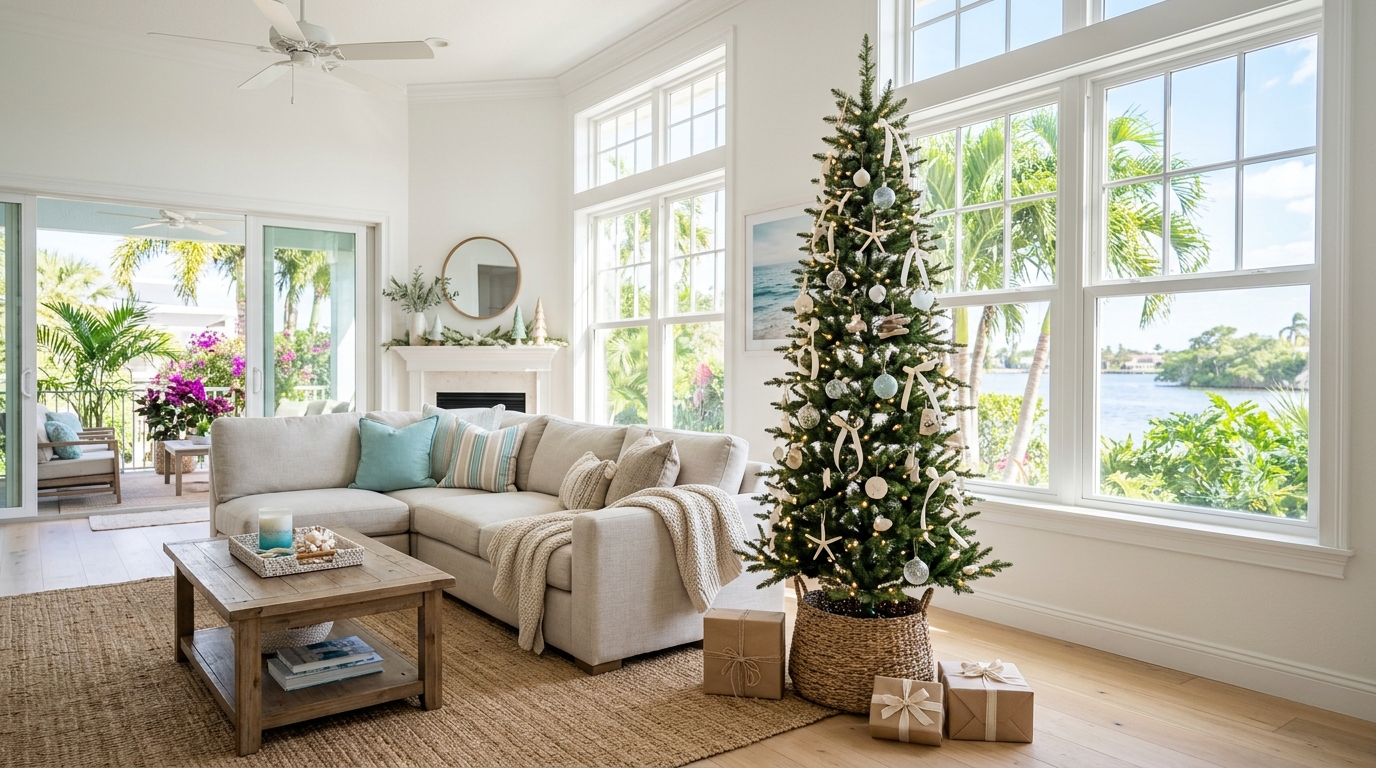
Two or three colors almost always outperform a full rainbow. In Florida, warm whites, deep greens, and a single metallic accent work well without competing with the bright natural surroundings. Coastal palettes of white, sand, and soft blue also read as holiday-appropriate when paired with greenery, and they tend to age better against Florida’s year-round landscaping.
Avoid mixing more than one metallic. Silver and gold together can look busy under bright Florida sun, and red-and-green can overwhelm a small porch if used at full saturation across every surface. If you want red, keep it to a single focal point — a ribbon, a wreath, or a door hanging.
A simple palette rule that works
Pick one neutral (white, cream, or natural), one green (fresh or artificial), and one accent. Stick to that combination across the yard, porch, and interior. Any new decoration must fit it or be skipped.
Replace Snow Imagery with Tropical and Coastal Elements
Nothing screams “trying too hard” in Florida quite like inflatable snowmen next to palm trees. Local materials make decorations feel natural and reduce the amount of store-bought décor you need.
Consider using:
- Palm fronds sprayed lightly with gold or white
- Real magnolia leaves, which last longer than most cut greenery in warm weather
- Fresh citrus — oranges, lemons, or grapefruits — in bowls or hung as garland
- Coastal accents like rope, driftwood, or shells in neutral tones
- Native or tropical potted plants wrapped simply in burlap or ribbon
These elements do more visual work than a pile of small ornaments, and they allow you to decorate with fewer objects overall.
Motion Lights vs. Static Lights: Which Fits Better in Florida
Motion lights have become popular in Florida because they add movement and visual interest without requiring wall-to-wall coverage. Static lights still have a place, but the two serve different purposes and mixing them carelessly is one of the fastest ways to overdo a display.
| Feature | Motion Lights | Static Lights |
|---|---|---|
| Visual impact | High with fewer units | Depends on quantity |
| Wiring needs | Often low or solar-powered | Usually requires more cords |
| Best use | Focal points, projectors, feature trees | Outlines, rooflines, garlands |
| Weather exposure | Must be IP65+ for full exposure | Rated outdoor strings are sufficient |
| Risk of overdoing | Low if used in one or two spots | High when every surface is covered |
A practical rule: pick one or two motion features for the most visible area — a tree, a garage door, or a front window — and use static lights only for accent lines. This produces a cleaner result and reduces the “everything is moving” effect that quickly becomes exhausting to look at.
Decorate in Stages and Stop Early
Most overdone displays happen because decorations are added in one long session with no evaluation. A better method is to build in stages and pause between each.
- Start with lighting only. Set up your main lights and stop for the day.
- View the house from the street at night. If it already looks complete, you may be done.
- Add greenery or garland next, keeping it to entryways and one focal wall.
- View again. Add accents only if something genuinely feels empty.
- Finish with interior touches that are visible through windows.
The pause between stages is what prevents excess. Florida homes are often highly visible from the street, so a display that looks finished from the curb is usually the right stopping point.
Common Florida Decorating Mistakes
Certain errors appear again and again in Florida holiday setups, and each makes the “overdone” problem worse.
- Using indoor-rated lights outside — They fail quickly in humidity, forcing replacements that never quite match.
- Covering every available surface — Density reads as clutter in bright, open Florida spaces.
- Mixing too many themes — Coastal, traditional, and whimsical styles competing in one yard cancel each other out.
- Ignoring daytime appearance — In Florida, decorations are visible in full sun for most of the day, so unlit clutter still looks cluttered.
- Forgetting wind — Lightweight inflatables and unsecured signs end up in the neighbor’s yard after the first storm.
- Overloading the entryway — A wreath, garland, sign, mat, and lanterns on a small Florida porch quickly becomes crowded.
Simple Interior Approach That Matches the Exterior
Interior decorating in Florida should echo the restraint you used outside. A single decorated tree, one mantel or console display, and a few coordinated accents are usually enough. Because many Florida homes have open sightlines, too many small items on every surface create visual noise that’s hard to ignore.
Focus on:
- One main decorated tree with a consistent palette
- Natural greenery on one or two high-visibility surfaces
- Warm, non-flickering lighting rather than multiple competing light colors
- Textiles like throws and pillows in the same palette as the exterior
When the inside and outside share a palette and material language, the entire home feels intentional rather than like two separate projects.
Frequently Asked Questions
How many decorations are too many for a Florida home?
There’s no fixed number, but a useful guideline is the street test: if you can’t easily identify the main focal point from the curb, there’s likely too much. Aim for one clear anchor per visible area rather than filling every surface.
Are real wreaths and garlands a bad idea in Florida?
They can work, but they dry out quickly in heat and humidity. Magnolia, citrus, and other sturdy greens last longer than delicate options like pine. For anything exposed to full sun or rain, artificial greenery rated for outdoor use is usually more practical.
Do motion lights use more electricity than static lights?
Not necessarily. Many motion and projector lights use LED technology with modest power draw, and solar-powered options use no household electricity at all. Consumption depends on the specific product rather than the category.
Can I decorate a Florida condo or apartment without a yard?
Yes. Focus on the door, a single window, and a small balcony if you have one. A wreath, one string of lights, and a potted plant are usually enough for a balcony or entryway, and they avoid the crowding that happens when every surface is filled.
When should I put up and take down Florida Christmas decorations?
Because heat and sun degrade materials, many Florida residents put decorations up later than northern households do — often the first week of December — and remove them shortly after New Year’s. This limits prolonged UV exposure and keeps greenery looking fresh.
What’s the biggest mistake people make decorating for Christmas in Florida?
Trying to recreate a cold-climate Christmas. Snow imagery, heavy fabrics, and dense traditional displays fight the environment. Working with tropical greenery, lighter palettes, and climate-appropriate lighting produces a result that looks intentional rather than mismatched.
Conclusion
Decorating a Florida home for Christmas without overdoing it comes down to three decisions: choose climate-appropriate materials, limit your palette to two or three colors, and stop adding once the display reads clearly from the street. Tropical greenery, restrained lighting, and a few strong focal points will always look better than a dense, mismatched setup in Florida’s bright, humid environment. Build in stages, evaluate after each one, and let the natural landscape carry part of the visual load.
Sorry, the comment form is closed at this time.